
Ratings, Listings, and the Federal Data Push: Why Practice Information Accuracy Became a Growth Problem
MFG Wellness: Where Healthcare Meets Marketing
For most of the last decade, a practice’s scattered online listings were a nuisance handled by whoever had time. That era is closing from two directions at once — federal infrastructure on one side, patient behavior on the other.
On April 9, 2026, CMS announced the first wave of its HealthTech Ecosystem, introducing agency infrastructure, a new Medicare App Library, and patient-facing applications from more than fifty companies. The agency reported that over 700 organizations had pledged support since the initiative began, and framed the work around shared standards for identity, security, and interoperability — moving past clipboards and fax machines toward a model where a patient shares information with a scan.
The implication for individual practices is easy to miss. As federal infrastructure standardizes around machine-readable provider data, the version of your practice circulating in databases starts to matter as much as the version on your homepage. Stale hours, a departed clinician, or an outdated accepting-new-patients flag no longer just inconveniences a caller. It propagates.
The Same Data Feeds the AI Answer
That propagation problem determines whether a practice surfaces when a patient asks an AI assistant for a local recommendation — the dynamic examined in AI Search Has Become Healthcare’s Front Door — and Most Practices Aren’t in the Room. Contradictions between sources get resolved somewhere, and not always in the practice’s favor.
Reviews Are Already Near-Universal
Whether a practice participates in review platforms stopped being a choice some time ago. A large-scale analysis published in JMIR Formative Research in April 2026 examined 201,154 U.S. surgeons identified through CMS provider datasets and found that 94.19 percent had a profile on at least one patient-initiated rating platform and 78.86 percent had at least one actual rating. About 91 percent of the U.S. population lives in a county with at least one surgeon carrying ten or more reviews.
Ratings skewed positive, with a weighted average of 4.12 out of 5 — undercutting the common fear that these platforms function mainly as complaint boards. Surgeons recognized by peers as “Top Doctors” carried both higher ratings and higher review volume. The authors also cited prior survey work finding that 86 percent of respondents read online reviews before choosing a physician and 73 percent preferred providers rated four out of five or higher.
The uncomfortable finding is the sampling problem. Surgeons at both the highest and lowest rating tiers tended to have very few reviews. A thin profile is not neutral — it is volatile, and one unhappy patient can define it.
What Accuracy Work Involves
Audit every listing surface where the practice appears. Reconcile name, address, phone, hours, specialties, languages, telehealth availability, and new-patient status. Retire profiles for clinicians who have left. Build a steady, ethical review habit so the sample is large enough to be stable.
How that data is collected and tracked carries its own constraints, detailed in The New Rules of Healthcare Website Tracking: What Practices Can and Can’t Measure in 2026.
Frequently Asked Questions
How many reviews does a practice actually need?
Enough that no single review moves the average. The JMIR analysis found a median of ten ratings among rated surgeons, with both the best- and worst-rated tiers concentrated among profiles holding fewer than ten.
Can we ask patients to leave reviews?
Requesting reviews is generally acceptable, but incentivizing them or filtering out negative responses before they post is not. Keep the ask neutral and offer it to everyone.
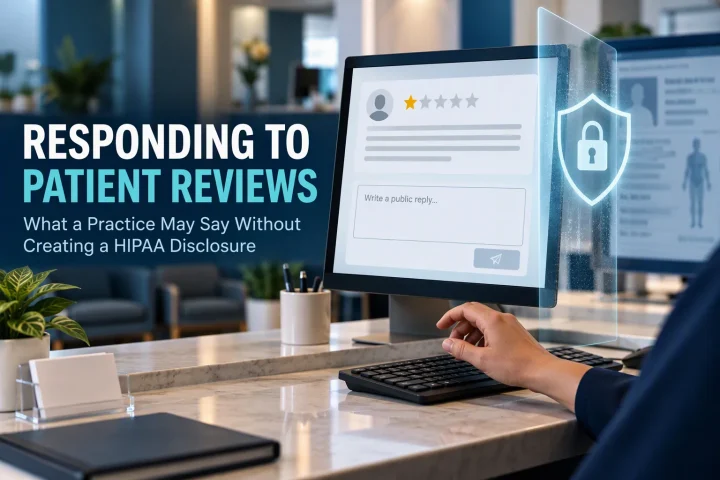
Can we respond to a negative review online?
Carefully. Confirming that someone was a patient can itself be a disclosure. Most practices respond with a generic invitation to contact the office directly — and should confirm their approach with counsel.
Which listing fields matter most?
Name, address, phone, hours, specialty, and accepting-new-patients status. Those are the fields patients act on and the fields AI platforms most often get wrong.
Disclaimer: This article is for general informational purposes and does not constitute legal or regulatory advice. Practices should consult qualified counsel regarding requirements applicable to their organization.
MFG Wellness: Built Exclusively for Healthcare
We manage the local visibility and listing accuracy work that determines whether a practice shows up correctly when patients — and the platforms they use — go looking.
Our Services Include:
- Healthcare SEO — Local search, listing consistency, and Google Business Profile management for medical practices
- Healthcare Digital Marketing — Coordinated strategy across search, paid, and content channels
Not sure what’s out there about your practice? Contact MFG Wellness for a listing and visibility audit.
Works Cited
Geng, Michael, et al. “Coverage, Traits, and Geographic Distribution of Online Surgeon Reviews: Large-Scale Cross-Sectional Analysis.” JMIR Formative Research, vol. 10, 14 Apr. 2026, pmc.ncbi.nlm.nih.gov/articles/PMC13078610/. Accessed 4 Aug. 2026.
“CMS Launches First Wave of HealthTech Ecosystem Tools, Fast-Tracking a Fully Digital, Patient-Centered Health System.” Centers for Medicare & Medicaid Services, 9 Apr. 2026, www.cms.gov/newsroom/press-releases/cms-launches-first-wave-healthtech-ecosystem-tools-fast-tracking-fully-digital-patient-centered. Accessed 4 Aug. 2026.