
MFG Wellness | Where Healthcare Meets Marketing
Most conversations about healthcare marketing compliance go straight to HIPAA. For a provider, that skips the regulator with the most direct hold over their livelihood.
Your state licensing board regulates what you may say in an advertisement, and it is the body that can act against your license rather than your bank balance.
The rules are specific, and they differ by profession
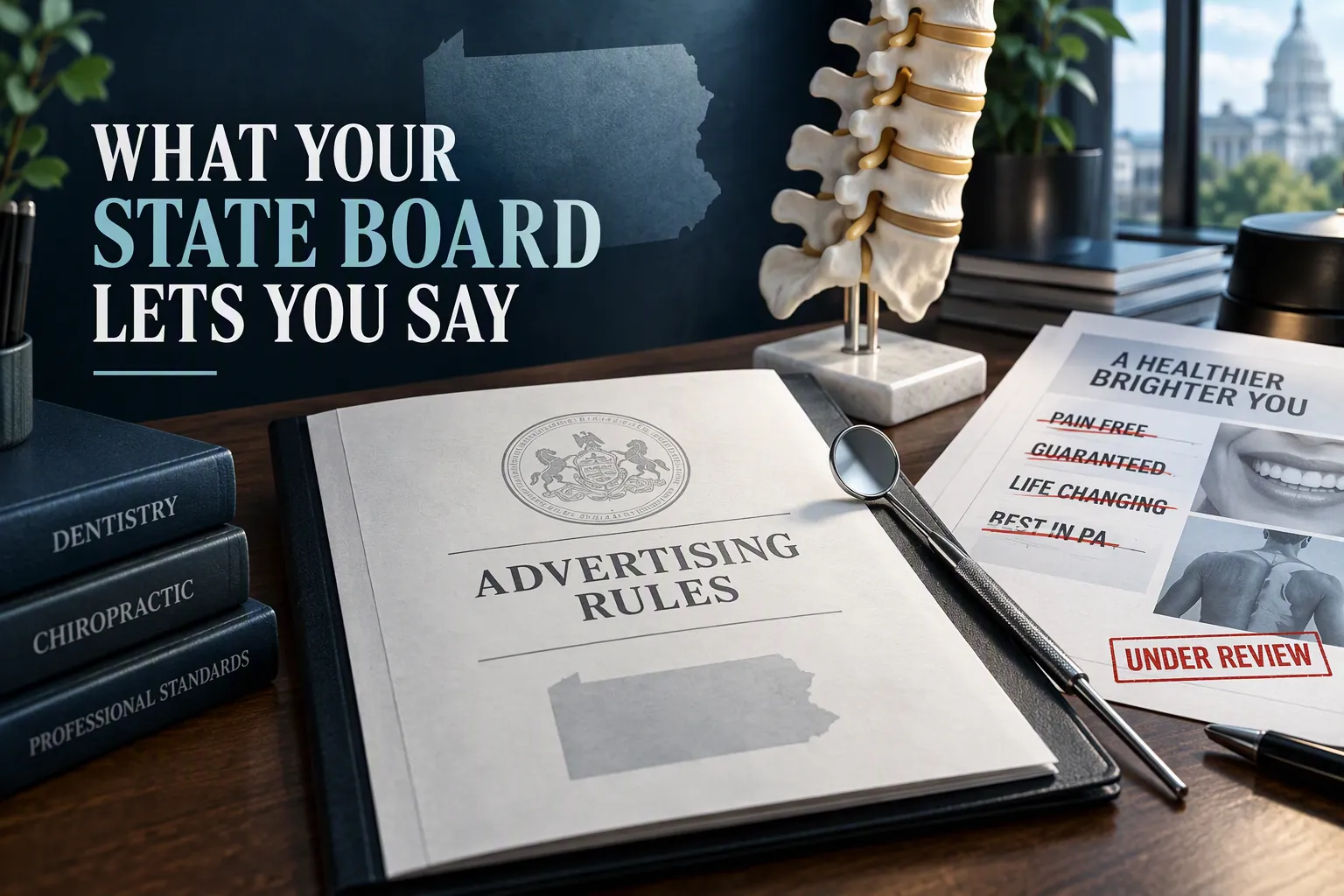
Pennsylvania is a useful illustration because the boards publish their rules and the rules do not match each other.
The State Board of Dentistry’s advertising regulation at 49 Pa. Code § 33.203 prohibits advertising that is false, misleading, or deceptive, and defines that to include an advertisement containing a material misrepresentation of fact, omitting a fact necessary to keep the statement from being materially misleading, that is likely to create an unjustified expectation about results the dentist can achieve, or that compares the advertising dentist’s services with other dentists’ unless the comparison can be factually substantiated.
The State Board of Chiropractic’s rule at 49 Pa. Code § 5.31 treats false, fraudulent, deceptive, or misleading advertising as unprofessional conduct, and includes advertising that creates false or unjustified expectations of beneficial treatment or a successful result, or that is designed to inflame or appeal primarily to a layperson’s fears, ignorance, or anxieties about their health.
Read those side by side and the shared ground is obvious. Both treat an unjustified expectation of results as the core problem.
Where “specialist” becomes a regulated word
The dentistry rule is the more detailed of the two on this point. It provides that an advertisement may not hold out or imply that a dentist is a specialist unless the area is recognized by the Board as a dental specialty, and the Board has adopted the American Dental Association’s list: dental public health, endodontics, oral and maxillofacial surgery, oral pathology, orthodontics, pediatric dentistry, periodontics, and prosthodontics.
The rule goes further. It states that neither general dentists nor specialists may hold out or imply that a non-specialty area has specialty status, giving the example that a dentist may not state they specialize in or limit their practice to temporomandibular joint disorders or implantology, while they may announce services in those areas or a practice limited to them.
The distinction between “we specialize in implants” and “our practice is limited to placing dental implants” is not a stylistic preference. One is addressed by the regulation and the other is the phrasing the regulation describes as available.
The chiropractic rule reaches the same territory differently, treating a representation that the licensee holds certification in a chiropractic specialty they do not hold as deceptive. The chiropractic chapter also lists failure to include the word chiropractor, chiropractic, D.C., or a derivative in advertisements, letterhead, signs, and other printed material among unprofessional conduct.
Why this lands on the marketing agency
Nothing above is exotic. All of it is the standard vocabulary of marketing copy.
“Specialist.” “Leading.” “Best results.” “Finally, relief from the pain you have been living with.” Every one of those is the kind of phrasing the two regulations above address, and every one appears routinely on practice websites written by agencies that never read a board regulation.
The dentistry rule contains one provision that should concentrate the mind. The dentist responsible for an advertisement has to furnish the Board with a copy of it within 20 days of being asked.
The agency wrote it. The licensee answers for it.
What to actually do about it
Pull the regulation for your profession in your own state and read it. They are short, they are public, and most providers have never looked at the one that governs them.
Then read your own website against it. The headline on the homepage, the service page introductions, any claim about outcomes, any use of “specialist,” any before-and-after imagery, and anything a patient could read as a promise about results.
Boards differ by state. A phrase cleared for a practice in one state says nothing about another, and multi-state groups carry the harder version of this problem.
What is published also shapes how practices are found now, which is covered in what patients actually ask AI before they book and your own website versus being written about elsewhere.
Frequently Asked Questions About Board Advertising Rules
Does HIPAA cover what I say in an advertisement?
HIPAA governs protected health information. What a provider may claim about their services is governed largely by the state licensing board and by federal advertising law. They are separate regimes, and an advertisement can satisfy one while breaching the other.
Can I say my practice specializes in something?
It depends on your profession, your state, and whether the area is a recognized specialty. Pennsylvania’s dentistry rule limits specialty claims to Board-recognized areas and describes alternative phrasing, such as announcing a practice limited to a service.
Are before-and-after photographs allowed?
Boards treat them as advertising claims subject to the same standards, particularly the rules on unjustified expectations of results. How they may be used varies by board and by state, so check your own board’s regulation before publishing any.
Who is responsible if the agency wrote the copy?
The licensee. Pennsylvania’s dentistry rule requires the dentist responsible for an advertisement to furnish the Board with a copy within 20 days of being asked. The agency is not the party the Board acts against.
Do these rules apply to social media posts?
Boards generally regulate advertising by its content rather than its format. The Pennsylvania chiropractic provision references advertisements, letterhead, signs, and other printed material, and practices should assume online content is treated as advertising.
How do I find the rule for my profession?
State boards publish their regulations publicly, usually through the state code. Search your state’s code for your board’s chapter and look for the advertising or unprofessional conduct section. Confirm anything you plan to rely on with your counsel.
MFG Wellness: Copy Written Against the Rule, Not Around It
MFG Wellness works exclusively with healthcare providers, from York, Pennsylvania, across chiropractic, dental, medical, and behavioral health practices. Each of those answers to a different board, which is why the same homepage headline cannot be reused across them.
How we work on it:
- Industries Served: We treat the regulator as part of the brief, since a chiropractic board and a dental board describe permissible advertising in different language
- Healthcare Website Design: Sites built around credentials, services, and what a first visit involves, which is the material boards do not restrict and patients actually look for
Not sure whether your current site would survive a board inquiry? Request a quote and we will read it against the regulation that applies to you.
Works Cited
Pennsylvania. “49 Pa. Code § 33.203. Advertising.” Pennsylvania Code and Bulletin, pacodeandbulletin.gov/Display/pacode?file=%2Fsecure%2Fpacode%2Fdata%2F049%2Fchapter33%2Fs33.203.html. Accessed 31 Aug. 2026.
Pennsylvania. “49 Pa. Code Chapter 5. State Board of Chiropractic.” Pennsylvania Code and Bulletin, pacodeandbulletin.gov/Display/pacode?file=%2Fsecure%2Fpacode%2Fdata%2F049%2Fchapter5%2Fchap5toc.html. Accessed 31 Aug. 2026.
Disclaimer
MFG Wellness is a healthcare digital marketing agency in York, Pennsylvania. We are not a law firm and do not provide legal or compliance services.
This article describes published Pennsylvania regulations as they stand at the time of writing, and describes them rather than interpreting how a board would apply them to any particular advertisement. Regulations differ by state and by profession, and they are amended. Nothing here states that any specific wording is permitted or prohibited in your situation. Current as of 31 August 2026.
This article is general information and is not legal or compliance advice. Healthcare regulations change and apply differently depending on your arrangement. Confirm current requirements with your compliance officer or counsel.